

Surf fishing, the captivating pursuit of angling from the sandy shores, offers a unique connection with the vast ocean. The rhythmic crash of waves, the salty air, and the anticipation of a powerful tug on the line create an experience unlike any other. However, success in surf fishing hinges on a multitude of factors, and one of the most crucial yet often overlooked elements is the size of your fishing hook. Selecting the correct hook size can be the difference between landing a prized fish and watching it swim away. This comprehensive guide will delve deep into the nuances of choosing the right hook size for surf fishing, providing you with the knowledge to optimize your tackle and increase your chances of a rewarding day on the beach.
Understanding the Importance of Hook Size in Surf Fishing
The hook is the critical link between you and your target species. It’s the point of contact, the instrument that secures the bait and ultimately penetrates the fish’s mouth. Therefore, choosing the appropriate hook size is paramount for several reasons:
Optimal Hookset:
A hook that is too small may not have a wide enough gap to effectively grab hold in the fish’s mouth, leading to missed strikes or the fish throwing the hook during the fight. Conversely, a hook that is too large can be cumbersome and unnatural for the bait, potentially deterring fish from biting altogether. The right size ensures a solid hookset, increasing your landing ratio.
Bait Presentation:
The size of your hook directly impacts how your bait is presented in the water. A hook that overwhelms a small bait will make it appear unnatural and unappetizing. Conversely, a hook that is too small for a large bait may not securely hold it, leading to it being easily lost or the hook point being obscured. Matching the hook size to the bait size and type is essential for attracting fish.
Fish Welfare:
Using the correct hook size also plays a role in responsible angling and fish welfare. A hook that is appropriately sized is more likely to lodge cleanly in the mouth, minimizing injury to the fish. Hooks that are too large can cause unnecessary damage, while hooks that are too small can result in gut hooking, which is often fatal. Choosing the right size promotes ethical fishing practices and increases the chances of a successful catch-and-release if desired.
Target Species:
Different fish species have varying mouth sizes and feeding habits. Therefore, the ideal hook size will vary depending on what you are targeting. For example, you would typically use a smaller hook for whiting or pompano compared to the larger hooks required for striped bass or sharks. Understanding the common species in your surf fishing location is crucial for making informed hook size decisions.
Decoding Hook Sizing Systems: A Necessary Foundation
Fishing hook sizes are denoted by a numbering system that can initially seem counterintuitive. Smaller numbers indicate larger hooks, while larger numbers indicate smaller hooks. For example, a size 1/0 (pronounced “one-aught”) hook is larger than a size 1 hook, which is larger than a size 2 hook, and so on. Once you move into the single-digit sizes, the numbers increase as the hook size decreases (e.g., a size 2 hook is larger than a size 4 hook).
“Aught” sizes (indicated by a forward slash and a zero, like 1/0, 2/0, 3/0, etc.) are used for larger hooks. As the number before the zero increases, so does the size of the hook. Single-digit sizes (1, 2, 4, 6, etc.) represent smaller hooks, and as the number increases, the size of the hook decreases.
Understanding this numbering system is fundamental to selecting the right hook for your surf fishing endeavors. It allows you to communicate effectively with tackle shop staff and to make informed choices when purchasing hooks.
Factors Influencing Your Surf Fishing Hook Size Selection
Several key factors should influence your choice of hook size when surf fishing:
Target Species:
As mentioned earlier, the primary determinant of hook size is the fish you are hoping to catch. Research the typical mouth size of your target species. Larger fish with bigger mouths, such as striped bass, bluefish, and sharks, will require larger hooks (e.g., 2/0 to 8/0 or even larger for big sharks). Smaller fish with smaller mouths, like whiting, pompano, and croaker, will necessitate smaller hooks (e.g., size 2 to 6).
Bait Size and Type:
The size and type of bait you are using should also dictate your hook size. The hook should be proportionate to the bait, allowing for natural presentation and a secure hold.
- Small Baits (e.g., sand fleas, shrimp, small worms): For smaller baits, use smaller hooks (size 4 to 8) to avoid overpowering the bait and hindering a natural presentation.
- Medium Baits (e.g., cut bait pieces, squid strips, larger worms): Medium-sized hooks (size 1 to 4) are generally suitable for these baits.
- Large Baits (e.g., whole mullet, bunker chunks, crabs): Larger baits require larger hooks (size 1/0 and up) to ensure a secure hold and proper presentation.
Consider the profile of your bait as well. A bulky bait might require a hook with a wider gap to ensure the hook point is exposed for a good hookset.
Water Conditions and Current:
In strong currents or rough surf, a slightly larger hook might be beneficial to help keep your bait anchored and prevent it from washing away easily. However, avoid going too large, as it can still deter fish.
Hook Style and Material:
Different hook styles and materials can also influence your size selection. For instance, circle hooks, which are designed to hook fish in the corner of the mouth, often require a slightly different sizing approach compared to J-hooks. The gauge (thickness) of the hook wire can also play a role. Thicker wire hooks are stronger but might require a slightly larger size for the same gap.
Regulations:
Always be aware of any local fishing regulations regarding hook size restrictions for specific species or fishing locations. These regulations are often in place for conservation purposes.
Recommended Hook Sizes for Common Surf Fishing Species
Specific conditions and bait choices can influence your final decision. However, here are some general recommendations for hook sizes when targeting popular surf fishing species:
- Striped Bass: Size 2/0 to 6/0 J-hooks or 4/0 to 8/0 circle hooks, depending on bait size.
- Bluefish: Size 1/0 to 4/0 J-hooks or 2/0 to 6/0 circle hooks, known for their aggressive strikes, slightly larger and stronger hooks are often preferred.
- Flounder: Size 2 to 4 J-hooks or 1/0 to 3/0 circle hooks, smaller mouths require appropriately sized hooks.
- Pompano: Size 2 to 6 J-hooks or 1/0 to 4/0 circle hooks, smaller hooks are generally more effective.
- Whiting: Size 4 to 8 J-hooks or 2/0 to 6/0 circle hooks, similar to pompano, smaller hooks are key.
- Redfish (Red Drum): Size 1/0 to 4/0 J-hooks or 3/0 to 6/0 circle hooks, depending on the size of the fish and bait.
- Black Drum: Size 1/0 to 5/0 J-hooks or 3/0 to 7/0 circle hooks, similar considerations to redfish.
- Sharks: Size 5/0 to 12/0 or larger circle hooks, depending on the species and size of shark being targeted. Regulations often dictate minimum hook sizes for shark fishing.
Important Note: These are general guidelines. Always consider the specific bait you are using and the average size of the fish in your local waters. Having a variety of hook sizes in your tackle box is often beneficial. It allows you to adapt to changing conditions and target different species effectively.
The Debate: J-Hooks vs. Circle Hooks in Surf Fishing
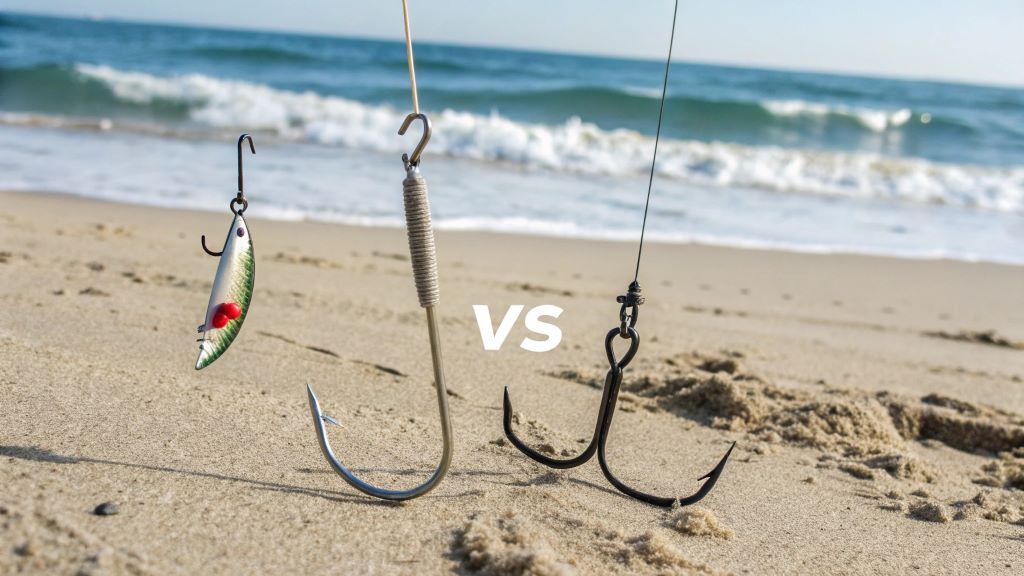
Surf anglers often debate the merits of J-hooks versus circle hooks. Both have their advantages and disadvantages:
J-Hooks: These are the traditional style of hooks with a curved shape and a sharp point that is typically offset.
- Pros: They generally offer a quicker hookset when a fish bites down on the bait. Many anglers are familiar with the technique of setting the hook with a sharp jerk of the rod when using J-hooks.
- Cons: They have a higher potential for gut hooking if the fish swallows the bait deeply before the angler can react. This can be detrimental to the fish, especially if catch-and-release is practiced.
Circle Hooks: These hooks have a distinct circular shape with the point turned inwards towards the shank. They are designed to hook the fish in the corner of the mouth as the line comes tight and the hook slides out.
- Pros: They significantly reduce the incidence of gut hooking, making them a more ethical choice for catch-and-release fishing. They often result in solid hooksets in the corner of the mouth, which is a strong and reliable hold.
- Cons: They require a different hooksetting technique. Instead of a sharp jerk, a slow, steady retrieve or tightening of the line is needed to allow the hook to do its job. Some anglers find the hookset less intuitive initially.
For surf fishing, both J-hooks and circle hooks can be effective. Many anglers prefer circle hooks for bait fishing, especially when using natural baits that fish might swallow. J-hooks can be popular for lure fishing or when a quicker hookset is desired. Ultimately, the choice often comes down to personal preference and the specific fishing situation.
Practical Tips for Choosing and Using Surf Fishing Hooks
- Match the Hatch (and the Mouth): Observe the natural prey in your fishing area and try to match your bait size and hook size accordingly. Consider the typical mouth size of your target species.
- Err on the Side of Slightly Larger (Within Reason): A hook that is slightly too large is generally better than one that is too small, as a small hook might not provide a secure hookset. However, avoid going so large that it makes your bait presentation unnatural.
- Consider the Bait Rig: The type of rig you are using can also influence your hook choice. For example, a fish finder rig might let a fish take the bait and swim away before feeling any resistance. This can be especially advantageous when using circle hooks.
- Sharpen Your Hooks: A sharp hook is essential for a quick and clean hookset, regardless of size. Regularly check the sharpness of your hooks and sharpen them as needed.
- Carry a Variety: Keep a selection of different hook sizes and styles in your tackle bag to be prepared for various species and bait options.
- Observe and Adapt: Pay attention to your hook-up ratio. If you are missing a lot of fish, you might need to adjust your hook size or style. If you are frequently gut-hooking fish, consider switching to circle hooks.
People Also Ask (FAQs)
Q: What is the best all-around hook size for surf fishing?
A: There isn’t a single “best” all-around hook size for surf fishing because it heavily depends on the target species and the bait being used. However, a selection of J-hooks in sizes 1/0, 2, and 4, along with circle hooks in sizes 2/0, 3/0, and 4/0, would provide a versatile starting point for many common surf fishing scenarios.
Q: Are bigger hooks always better for bigger fish?
A: Generally, yes, larger fish with larger mouths require larger hooks for a secure hookset. However, the hook should still be appropriately sized for the bait. An oversized hook on a small bait can deter fish.
Q: Can I use the same hook size for different types of bait?
A: While you might be able to use a similar hook size for baits of comparable size, it’s often best to tailor the hook size to the specific bait. A bulky bait might require a wider gap, while a delicate bait needs a hook that won’t overpower it.
Q: How do I know if my hook is too small?
A: Signs that your hook might be too small include frequent missed strikes, fish throwing the hook easily during the fight, or the hook being completely swallowed.
Q: How do I know if my hook is too big?
A: If fish are nipping at your bait but not committing, or if your bait presentation looks unnatural due to the size of the hook, your hook might be too large.
Q: Are circle hooks mandatory in some surf fishing situations?
A: In some regions or for certain species (like sharks in many areas), regulations may mandate the use of circle hooks to promote better catch-and-release practices. Always check local regulations.
Q: What type of hook is best for live bait in surf fishing?
A: Both J-hooks and circle hooks can be effective for live bait. Circle hooks are often preferred because they reduce the risk of gut hooking. However, some anglers find that J-hooks provide quicker hooksets when using live bait.
Q: How does water temperature affect hook size choice?
A: Water temperature doesn’t directly dictate hook size, but it can influence fish behavior and feeding habits. In colder water, fish might be more lethargic and have softer bites, potentially making smaller hooks more effective. Conversely, in warmer water, more aggressive fish might handle larger baits and hooks more readily.
Q: Should I use treble hooks for surf fishing?
A: Treble hooks are generally not recommended for bait fishing in the surf due to the increased risk of gut hooking. They are more commonly used on lures. If using lures with treble hooks, consider replacing them with single hooks for better fish welfare.
Q: How often should I change my surf fishing hooks?
A: You should change your hooks if they become rusty, bent, or dull. Saltwater is corrosive, so regular inspection and replacement are essential to ensure you have sharp and reliable hooks.
Conclusion: Mastering the Art of Hook Selection for Surf Fishing Success
Choosing the right hook size for surf fishing is a critical skill that can significantly impact your success on the sand. By understanding the hook sizing system, considering factors like your target species, bait type, and water conditions, and staying informed about local regulations, you can make informed decisions that lead to more hook-ups and responsible angling practices. Experimentation and observation are key. Pay attention to what works in your local waters and don’t be afraid to adjust your hook size and style based on your experiences. With the right hooks in your tackle box and a good understanding of how to use them, you’ll be ready for the surf. This preparation will make landing your desired catch a more rewarding experience.
Read More:
How to Put Fins on a Surfboard: A Beginner’s Guide to Setup and Performance